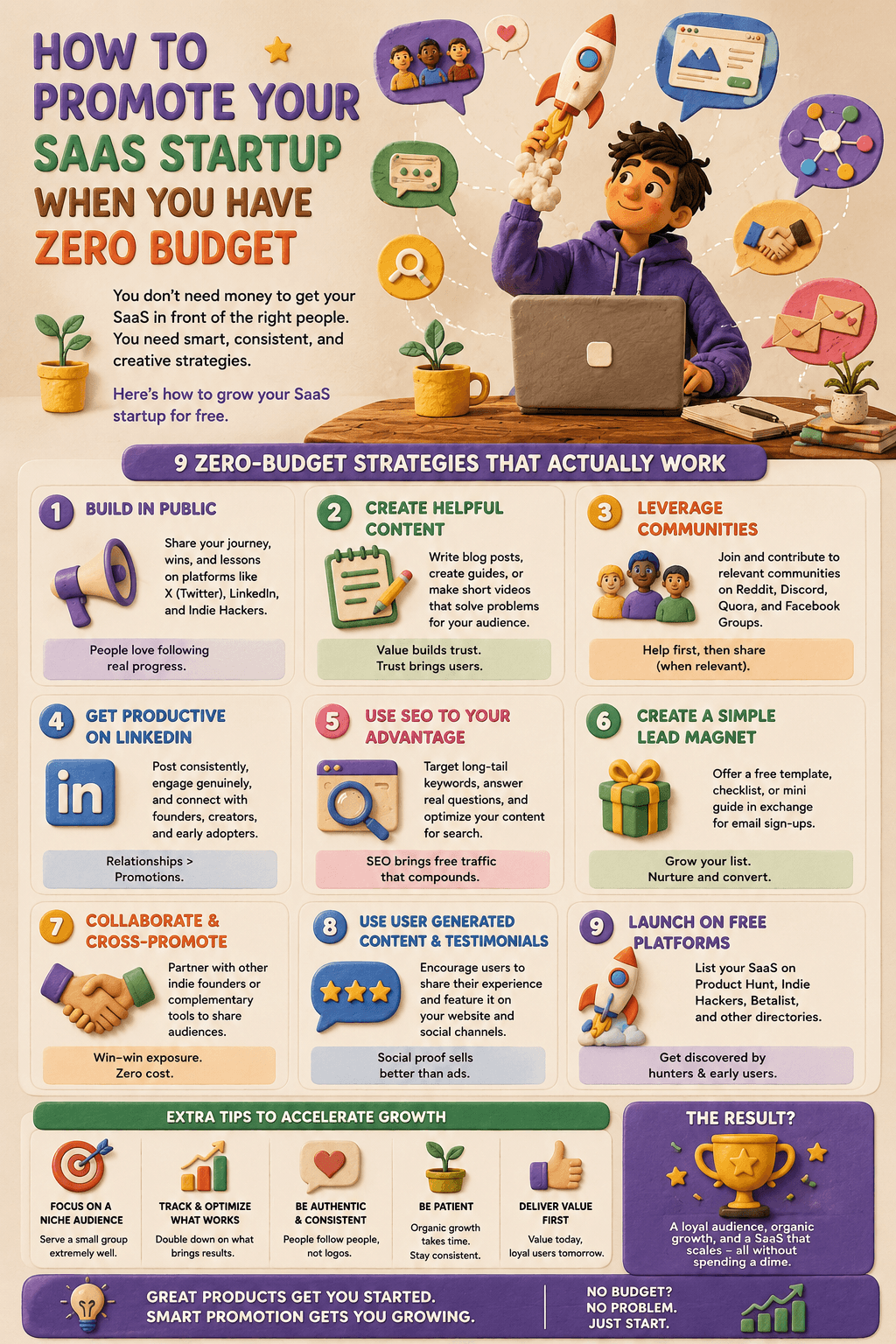
Let’s deal with the premise honestly before getting into tactics, because most articles with this title do not. “Zero budget” almost never means zero cost. It means you are substituting time, skill, and personal risk tolerance for cash. That distinction matters enormously, because a founder who spends 25 unpaid hours a week for four months on content and community building has spent something real, something with an opportunity cost that a lucky few can afford and most cannot. If you have a mortgage, a family depending on your income, or a day job you cannot walk away from, “zero budget” marketing is not free. It is expensive in a currency that just does not show up on a bank statement.
With that framing out of the way, the good news is real: SaaS has one of the lowest floors for organic growth of any business category, because the product itself can do marketing work that a physical business never could. A founder with genuine skill, a real problem worth solving, and enough runway to be patient can build meaningful traction without spending on ads. This is not theory. It happens regularly. What follows is a practical breakdown of the channels that actually work, paired with an honest account of where each one is likely to disappoint you, because a strategy that only tells you the upside is not a strategy, it is a pitch.
Why “Zero Budget” Filters Out More Founders Than It Helps
Before going channel by channel, it is worth naming a structural problem with the zero-budget SaaS narrative: survivorship bias runs thick through nearly every success story you will read about it. For every founder who bootstrapped to seven figures through Product Hunt and content marketing, there are hundreds who ran the identical playbook and produced nothing. Harvard Business School research by professor Shikhar Ghosh, widely cited in bootstrapping literature, found that roughly 75% of venture-backed startups fail to return capital, and the mortality rate for founders trying to grow with zero marketing spend and no outside validation is almost certainly higher, not lower, even if it is measured less rigorously because these failures rarely get written up.
That is not a reason to avoid the zero-budget path. It is a reason to be skeptical of any framework, including this one, that implies these tactics are a reliable formula rather than a set of levers whose success depends heavily on product quality, market timing, and founder skill that no article can supply for you. If your product does not yet solve a real problem well, no amount of clever distribution will save it, which is why it pays to test a SaaS idea with real crowds before you promote it. Distribution tactics amplify what already exists. They do not manufacture demand for something people do not want.
The Core Channels, Ranked by Realistic Effort-to-Return
The table below is deliberately more skeptical than most “zero budget marketing” roundups. Every channel here works for someone. Not every channel will work for you, and the effort required is usually underestimated by an order of magnitude in the content that promotes these tactics.
| Channel | Real Cost | Typical Time to Traction | Realistic Risk |
|---|---|---|---|
| Launch platforms (Product Hunt, Hacker News) | Days of prep, one shot at a good launch | Immediate spike, fast decay | High effort, low retention if product isn’t ready |
| SEO content | 6 to 12 months minimum | Slow, compounding | Requires genuine writing skill or heavy time investment |
| Community building (Reddit, niche forums, Slack groups) | Ongoing weekly time | 3 to 6 months for trust | Easy to get banned for self-promotion if done wrong |
| Cold outreach (email, LinkedIn) | Time-intensive, low per-contact cost | Fast feedback, slow conversion | High rejection rate, deliverability risk without warmup |
| Building in public | Consistent posting over months | Unpredictable, hit-driven | Requires comfort with visibility and inconsistent payoff |
| Startup directories | Low time cost per submission | Minimal on its own | Marginal SEO value from most directories; treat as a supplement, not a strategy |
| Partnerships and integrations | Relationship-building time | 2 to 6 months | Depends entirely on finding partners with aligned incentives |
Notice that nothing in this table is instant, and nothing is guaranteed. If a piece of content promises a specific number of signups from any of these channels without qualifying it heavily, treat that number as marketing for whoever wrote it, not a forecast for your business.
Launch Platforms: Useful for a Spike, Not a Strategy
Product Hunt, Hacker News, and similar launch platforms remain genuinely useful, but their value gets overstated constantly. A strong Product Hunt launch can put your product in front of thousands of relevant, curious people in a single day. What it typically does not do is produce durable, paying customers at meaningful volume. The traffic spikes hard and decays within 48 to 72 hours, and the audience skews heavily toward other builders and tool enthusiasts rather than your actual target customer, unless your target customer happens to be other builders.
The honest use case for a launch platform is threefold: initial social proof you can reference later, direct user feedback from an engaged crowd, and a backlink or two from a reasonably authoritative domain. Treat anything beyond that as a bonus, not an expectation. If you are choosing where to submit beyond the obvious platforms, it is worth being selective rather than blasting your product across every directory that will accept it. A curated directory of launch platforms with domain rating and link data attached is more useful here than a generic list, because it lets you prioritize the handful of directories that carry real authority over the dozens that exist mainly to sell you a paid tier for a dofollow badge. That distinction matters: a dofollow link from a directory with a domain rating of 15 does close to nothing for your SEO, regardless of what the submission page promises.
SEO Content: The Slowest Channel That Actually Compounds
Content marketing is the channel most frequently recommended and most frequently abandoned, because the payoff timeline does not match founder expectations. Realistically, competitive SaaS keywords take six months to a year of consistent publishing before you see meaningful organic traffic, and that assumes the content is genuinely good, targeted at real search intent, and published consistently rather than in a burst followed by silence.
The mistake most zero-budget founders make with content is chasing volume over specificity. Ten generic posts about “how to be productive” will lose to one deeply specific post that solves an exact problem your target user is searching for, written with the kind of detail that only someone who has actually solved that problem could provide. If writing is not a strength you already have, this channel will consume far more time than the table above suggests, and it is worth being honest with yourself about whether you would be better served putting that same time into community building or outreach, where feedback loops are faster. A structured, phase-based approach to sequencing your limited time across marketing activities, similar to the time-budget framework built specifically for solo SaaS founders launching with no money, is worth studying before you commit months to any single channel, because the sequencing decision often matters more than the channel choice itself.
Community-Led Growth: High Ceiling, High Risk of Self-Sabotage
Reddit threads, niche Slack and Discord communities, and industry-specific forums can produce some of the most qualified traffic available to a zero-budget founder, because the people there have already self-selected into caring about your problem space. The risk is that these communities have strong, well-enforced norms against self-promotion, and a founder who shows up only to pitch their product gets banned, ignored, or quietly resented, which damages credibility that is hard to rebuild.
The founders who succeed here spend months providing genuine value before ever mentioning their product, answering questions, sharing real expertise, and building a reputation as someone worth listening to. Only then does mentioning a product they built land as helpful rather than as spam. This is slower and more emotionally demanding than it sounds, because it requires resisting the urge to promote when you are, understandably, anxious about traction. If you cannot sustain genuine participation in a community for months without an immediate payoff, this channel will underperform for you regardless of how well it worked for someone else’s case study.
Building in Public: A High-Variance Bet, Not a Reliable Channel
Sharing your journey, revenue numbers, and lessons learned on platforms like X and LinkedIn has produced some genuinely remarkable growth stories, and it has also produced thousands of accounts that posted consistently for a year and generated almost nothing. This is the highest-variance channel on this list, and the content that promotes it survivorship-biases hard toward the outliers.
If you choose this path, go in with realistic expectations: most posts will get modest engagement, a small number will occasionally break through, and the compounding value comes from accumulated trust and audience over a long period rather than any single viral moment. It also demands a genuine comfort with public vulnerability that not every founder has, and forcing yourself into a format that feels unnatural usually reads as inauthentic to the audience you are trying to build, which defeats the purpose entirely.
Cold Outreach: Underrated for B2B, Overused Poorly
Cold email and LinkedIn outreach get dismissed too quickly by founders who have only experienced them as the recipient of bad, generic pitches. Done with real specificity, targeting a narrow list of people who genuinely match your ideal customer profile, outreach remains one of the fastest ways to get direct feedback and early paying customers for B2B SaaS specifically. The reason most zero-budget founders fail at this channel is volume-over-precision thinking: sending 500 generic emails performs dramatically worse than sending 50 highly researched, individually relevant ones.
The real cost here is time per contact, not money, and the risk is underappreciated: sending outreach at any real volume without proper email warmup and authentication can damage your domain’s deliverability, which then hurts every other email you send, including transactional messages to actual customers. This is a genuine technical risk that many “just send cold emails” guides skip entirely.
Six Traps That Waste a Zero-Budget Founder’s Limited Time
Given that time is the actual currency being spent here, avoiding waste matters as much as picking good channels. These are the patterns that consume the most time for the least return.
- Spreading effort across too many channels at once. Doing five channels poorly loses to doing two channels well. Pick based on where your actual skills and your customer’s actual attention overlap, not based on what a listicle recommends.
- Submitting to every low-authority directory available. Most directory submissions produce negligible SEO value and negligible traffic. A handful of well-chosen, relevant, higher-authority listings beat fifty low-value ones.
- Confusing activity with progress. Posting daily, tweaking your landing page repeatedly, and researching tactics endlessly can feel productive while producing zero customer conversations, which is the only metric that matters at this stage.
- Ignoring unit economics until it’s too late. Even at zero marketing spend, know your realistic customer acquisition cost in time, your churn rate, and whether your pricing can sustain the business once you do convert users, because free traffic does not mean a free business.
- Treating a single launch spike as validated demand. A good Product Hunt day does not mean product-market fit. Watch what happens to usage and retention 30 and 60 days after the spike, not the vanity numbers from day one.
- Underinvesting in the follow-up sequence after initial interest. Getting someone to sign up is only the beginning. Zero-budget founders often pour all their effort into acquisition and almost none into the onboarding and retention work that actually turns interest into revenue.
Setting Realistic Expectations for the Path Ahead
If there is one thing worth internalizing before starting any of this, it is that zero-budget growth trades money for time and for founder skill, and that trade is not automatically a good one for every situation. A founder with strong writing ability, genuine community credibility in their target niche, or deep existing relationships with potential customers has real, non-obvious advantages that no tactic list can substitute for. A founder without those advantages will need considerably more time to build them from scratch, and being honest about that gap upfront prevents the kind of burnout that comes from expecting month-two results on a channel that realistically needs month-eight patience.
None of this means the path is not worth walking. It means walking it with clear eyes about what you are actually spending, what a realistic timeline looks like, and which of these channels genuinely fits how you work rather than which one has the best success stories attached to it. The founders who succeed with zero-budget growth are rarely the ones who executed a perfect playbook. They are the ones who picked one or two channels that matched their real strengths, stuck with them past the point where it felt discouraging, and paid close enough attention to their actual numbers to know the difference between slow progress and no progress.
Frequently Asked Questions
Yes, but “zero budget” should be understood accurately as zero cash spend, not zero cost. It requires substituting significant time, skill, and patience for money, and the realistic timeline to meaningful traction is measured in months, not weeks. Founders with existing writing ability, community credibility, or a genuinely differentiated product have real advantages here. Founders expecting fast results without those advantages are more likely to be disappointed than founders who go in with a longer, more skeptical timeline in mind.
Launch platforms like Product Hunt and Hacker News produce the fastest visible spike, often within 24 to 48 hours, but that spike rarely converts into durable, retained customers on its own. Cold outreach to a narrow, well-researched list typically produces the fastest genuine customer conversations, though volume is limited by the time required to research each contact properly. SEO content and community building are the slowest channels but tend to compound more reliably over six to twelve months for founders who stay consistent.
One or two, chosen deliberately based on where your actual skills and your target customer’s attention genuinely overlap. Attempting five or six channels simultaneously with limited time almost always produces mediocre execution across all of them rather than strong results in any one. It is better to under-diversify and go deep than to spread thin and generate insufficient signal to know whether any given channel is actually working.
Modestly, and mostly if you are selective. Directories with meaningful domain authority and relevant dofollow links can provide some SEO value and occasional direct traffic, but most directories carry low domain authority and contribute negligible ranking benefit. Treat directory submissions as a minor supplementary tactic rather than a core growth strategy, and prioritize quality and relevance over submitting to every directory that will accept your listing.
Confusing activity with progress. It is easy to spend weeks tweaking a landing page, researching tactics, or posting content while avoiding the harder, more vulnerable work of having direct conversations with potential customers. The founders who make real progress track a small number of meaningful metrics, primarily direct customer conversations and actual usage or conversion data, rather than vanity indicators like social media impressions or directory listing counts.
This depends on the channel. Give SEO content and community-led growth a genuine six-month runway before judging results, since both compound slowly and early efforts often look unproductive before they gain traction. Cold outreach and launch platforms provide much faster signal, typically within two to four weeks, because response rates and conversion data arrive quickly. If a slow-compounding channel shows genuinely zero traction after six months of consistent, quality effort, that is a legitimate signal to reassess rather than push forward on faith alone.
Infographic