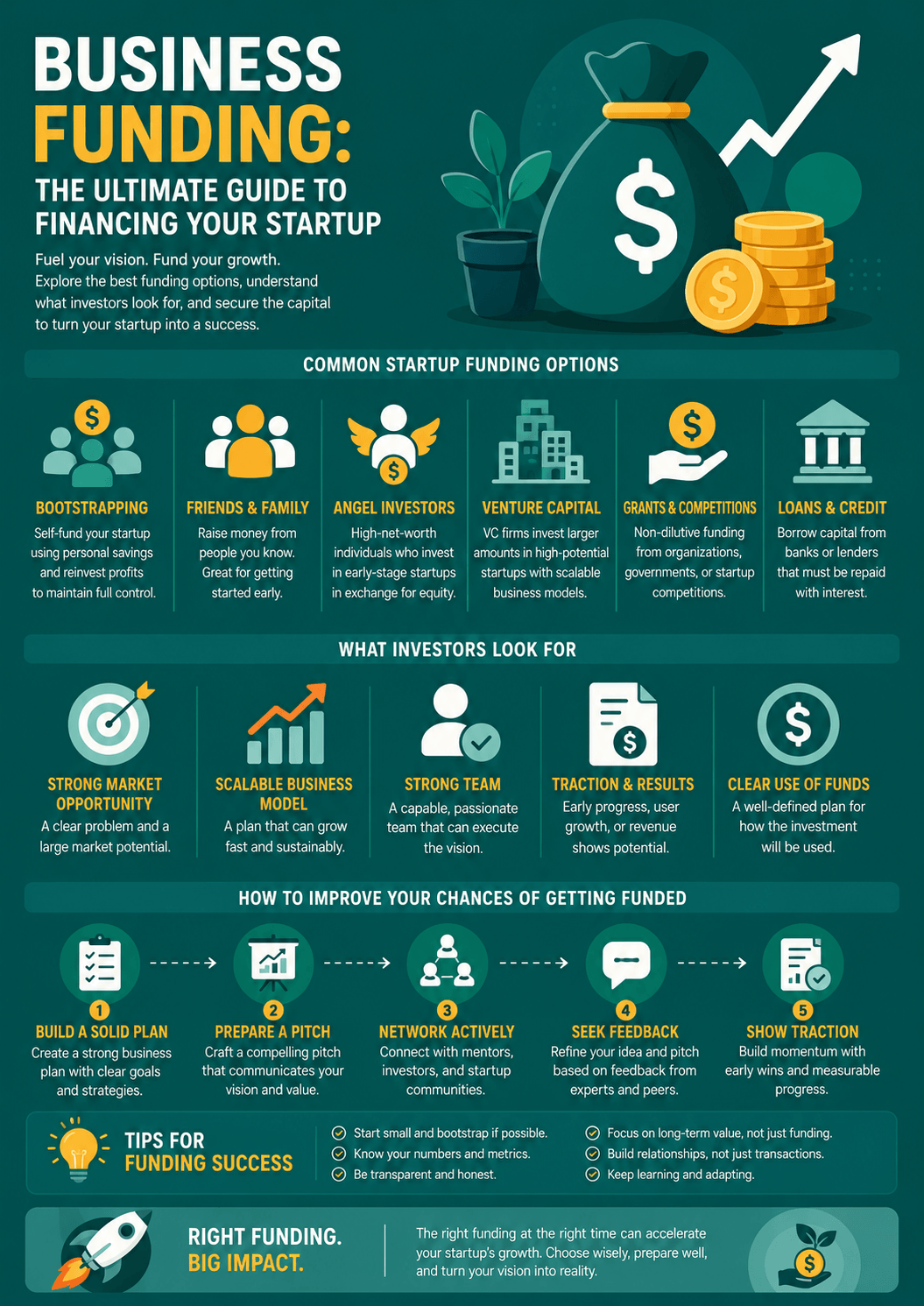
Every founder has a moment where they stare at their bank account and think: this is either going to work or it isn’t. That moment of reckoning is when funding stops being a theoretical concept and becomes a survival question. But here’s what separates the founders who close deals from those who run out of runway, it isn’t luck. It’s knowledge. Explore the ultimate business and startup funding guide to financing your dream.
Understanding the full landscape of startup financing. What’s available, what it costs, and what it ultimately changes about your company is one of the highest-leverage skills any early-stage founder can develop. This guide covers every major funding path, the tradeoffs you’ll need to weigh, and the strategic thinking that consistently separates funded startups from ones that fade quietly.
Why Getting Funding Right Changes Everything
Most first-time founders make the mistake of treating funding like a single event. Something that happens, and then you get back to building. In reality, capital decisions have very long tails. The valuation you set in your seed round affects your Series A. The equity you give away today affects what you can offer a critical co-founder next year. The loan you take on shapes your runway calculations for the next 18 months. Every funding decision made today becomes a constraint you live with tomorrow.
More importantly, the type of funding you choose sends a signal about the kind of company you’re building. A bootstrapped founder signals independence and profitability discipline. A VC-backed founder signals aggressive growth and an expectation of eventual liquidity. Neither path is wrong. But they are genuinely different journeys, and the best funding decision is the one that aligns with where you actually want to go, not simply where the money happens to be.
The Most Common Types of Startup & Business Funding
Before diving into each option individually, here’s a practical overview of how the major financing models compare for Business Funding:
| Funding Type | Best Stage | Typical Range | Equity Required | Primary Advantage |
|---|---|---|---|---|
| Bootstrapping | Pre-seed | Personal funds | None | Full control and ownership |
| Friends & Family | Pre-seed | $5K – $150K | Varies | Speed and trust |
| Angel Investors | Seed | $25K – $500K | 10–25% | Network and mentorship |
| Venture Capital | Series A+ | $1M – $100M+ | 20–40% | Scale at speed |
| Bank Loans / SBA | Any stage | $10K – $5M | None | Equity preserved |
| Government Grants | Early stage | Up to $500K | None | Non-dilutive capital |
| Crowdfunding | Pre-seed/Seed | $10K – $5M | Varies | Built-in market validation |
| Revenue-Based Financing | Growth | $50K – $5M | None | Flexible repayment structure |
Starting With What You Have: Bootstrapping
Bootstrapping gets romanticized and dismissed in equal measure, depending on which founder you ask. The truth is more nuanced than either extreme. Building from personal savings or early customer revenue forces a discipline that outside capital rarely teaches. So, every dollar spent came from somewhere real, and that accountability changes how teams prioritize, how products get scoped, and how quickly a business learns to generate genuine value.
Companies like Mailchimp and Basecamp bootstrapped to serious scale before ever touching outside money, doing so without giving away equity or answering to a board. That’s not a small thing. For founders who want to build profitable, sustainable businesses without the pressure of exponential growth expectations attached to institutional money, bootstrapping isn’t a consolation prize. It’s a deliberate and entirely legitimate strategy.
When Friends and Family Step In: Business Funding
Most early-stage companies raise their first outside capital from people who believe in the founder before believing in the business. That’s both the beauty and the inherent risk of the friends and family round. The money arrives quickly and with minimal friction. No term sheets, no due diligence calls, no pitch competitions. But the cost of failure lands close to home.
The most important thing any founder can do in a friends and family round is treat it professionally, even when the relationship is casual. Document every investment using a simple convertible note or written agreement that spells out the terms clearly. Never accept money from someone who genuinely cannot afford to lose it. A business failure is hard enough without a dinner table becoming awkward for the next decade.
Angel Investors: The Early Believers
Angel investors occupy a genuinely unique position in the startup ecosystem. They’re typically high-net-worth individuals investing their own capital. Not someone else’s fund and they often bring operational experience alongside their check. The best angel relationships feel less like traditional investor-founder dynamics and more like having a senior advisor who happens to have skin in the game.
Finding the right angels matters just as much as finding willing ones. An angel who has built and sold companies in your specific space can open doors, make introductions, and catch problems before they escalate into crises. An angel simply parking capital in startups may write the same check but deliver a fraction of the long-term value. When evaluating potential angels, ask directly about their portfolio, their typical involvement level post-investment, and specifically how they have helped other founders beyond the initial capital.
Venture Capital: Scaling With Purpose
Venture capital is built around a specific mathematical thesis: a small number of bets will return enormous multiples, and those returns will cover the losses across the rest of the portfolio. That math shapes everything about how venture investors behave. They aren’t looking for good businesses. They’re looking for businesses that could become extraordinarily large, fast.
That’s why taking institutional venture money is a genuine commitment to a particular trajectory. One that typically ends in acquisition or public offering, often within a defined timeframe. Many excellent businesses are simply not venture-backable by design, and some great founders have destroyed perfectly good companies by taking VC money and then failing to hit the aggressive growth targets attached to it. If you’re building a venture-scale company in a large and rapidly growing market, the right VC partner can be transformative. If you’re not, the term sheet can quietly become a trap.
Grants, Loans, and Government Programs for Business Funding
Here’s the funding category most early-stage founders dramatically underestimate: non-dilutive capital. Grants from government agencies, nonprofit organizations, and economic development programs exist specifically to help businesses grow and they require no equity in return. That makes them some of the most valuable capital available, even when the application process demands patience.
If you haven’t explored what grant programs exist in your region, industry, or business stage, you are very likely leaving real money on the table. The complete process of unlocking grants and funding for growing businesses from identifying the right programs to preparing compelling applications. So, is a step that many bootstrapped founders skip entirely, and often to their own disadvantage. SBA loans and USDA programs are also worth exploring for businesses that need meaningful capital without the dilution that equity financing demands.
Crowdfunding: Let the Market Decide
There’s something uniquely honest about a crowdfunding campaign. When real people voluntarily commit their own money, you get market feedback that no focus group can replicate. That’s why a successful campaign is valuable well beyond the dollars raised it creates tangible proof of demand that makes every subsequent fundraising conversation significantly easier to have.
The mechanics vary considerably by platform. Kickstarter and Indiegogo are rewards-based, meaning backers typically receive early access to your product rather than ownership. Republic and Wefunder are equity-based, giving backers an actual stake in the company. Both have delivered significant capital for the right products. The catch is that running a truly great campaign requires substantial upfront investment in storytelling, community building, and marketing. The companies that succeed at crowdfunding invest heavily in these elements long before launch day, not after it.
Common Mistakes That Kill Funding Rounds
Even well-prepared founders walk into avoidable traps. These are the ones that come up most consistently:
- Raising too early. Investors evaluate hundreds of pitches from founders who haven’t yet found product-market fit. Coming back with real traction is dramatically more effective than pitching on ideas alone.
- Over-diluting at the seed stage. Giving away 30–40% before Series A can make later fundraising nearly impossible. Protect your cap table aggressively from the start with Business Funding.
- Pitching investors who aren’t a fit. Research stage, sector, and check size before reaching out. A clear mismatch wastes everyone’s time and can damage your reputation in a small network.
- Underestimating how long a round takes. Most rounds close in 6 to 9 months. Starting a raise with 60 days of runway is a recipe for negotiating from weakness.
- Treating fundraising as a side task. It’s almost a second full-time job, and founders who don’t acknowledge that risk letting the company slide precisely when it needs attention most.
Your Online Presence Is Part of Your Funding Strategy
Before an investor reads your pitch deck, they’ve almost certainly searched for you online. Your website, your published content, your LinkedIn activity, and any press coverage all contribute to the impression you make before you walk into the room. Founders who treat their digital presence as a secondary concern are handing a real competitive advantage to their rivals.
A clean, professional, well-designed website built on a solid investment consulting WordPress theme communicates competence and attention to detail at a glance qualities investors notice before a single metric is discussed. Beyond presentation, investors pay close attention to whether founders actually understand their own numbers. Tracking and clearly communicating the financial health metrics that determine your business’s trajectory things like burn rate, gross margin, and revenue retention. So, signals to a sophisticated investor that you run a real operation, not just a vision. Companies that excel at attracting capital often do so by building their entire digital infrastructure with long-term credibility in mind, much like those that have approached building a business digital ecosystem from scratch with clear intentionality from day one.
How to Know When You’re Ready to Raise
The strongest position you can occupy when fundraising is one where you don’t desperately need the capital. That sounds counterintuitive, but investors can read urgency and it makes them risk-averse. The startups that close rounds fastest are usually the ones with options: companies that could survive without the raise but would grow significantly faster with Business Funding.
Before launching into investor outreach, get genuinely honest about whether you have the fundamentals in place: real users or paying customers, a clear and credible revenue model, a compelling narrative about your market opportunity, and a specific plan for what the capital will accomplish. Founders who have already built momentum through proven growth strategies for startups — referral programs, organic acquisition, strong content. So, tend to enter funding conversations with far stronger metrics to share. And if part of your fundraising story involves expanding into new markets, it’s worth studying why companies fail when entering new markets in depth before committing investor capital to that bet.
Frequently Asked Questions: Business Funding Guide
For most pre-revenue founders, bootstrapping combined with a friends-and-family round is the most realistic starting point. Government grants are also worth exploring seriously, especially for businesses with a social, scientific, or environmental impact angle. Angel investors will occasionally back pre-revenue ideas, but most want to see some early signal, a waitlist, a working prototype, or an unusually strong founding team before committing capital.
There’s no universal rule, but most seed-stage founders give away between 10% and 25%, depending on valuation and deal structure. The key principle is to protect sufficient ownership to remain a credible stakeholder through multiple future rounds. Founders who give away too much too early often find themselves in difficult negotiations before the company has had enough time to prove its value.
Team, market, product, and traction, roughly in that order, at the early stages. Team quality often matters more than the idea itself at the seed stage, because investors understand the idea will evolve. What they’re really evaluating is whether the founders have the judgment, persistence, and adaptability required to navigate the inevitable chaos of building something new in an unpredictable market.
Yes, and increasingly so. Most angel investors and venture funds evaluate companies based on pitch decks and conversations rather than formal business plans. What matters far more than the document itself is the clarity of your thinking. Whether you can articulate the problem, the solution, the market size, and the team in a way that feels both compelling and credible. Formal business plans remain most relevant for bank loan applications and grant submissions.
Longer than most founders expect. Seed rounds typically take 3 to 6 months from first outreach to capital in the bank. Series A and beyond often take 6 to 12 months. The more prepared you are before starting. A complete data room, a sharp pitch narrative, and warm relationships with target investors. Finally, the faster the process moves.
Absolutely. Venture capital is designed for a very specific type of business: one with the potential to grow exponentially and return significant multiples to investors within a defined timeframe. Most businesses don’t fit that profile by design, and many excellent companies have scaled to meaningful revenue and profitability without ever needing VC. The real question isn’t whether you can build without it. In conclusion, it’s a question of whether your business model genuinely requires the kind of capital VC provides, or whether a more measured approach would actually serve your goals better.
Infographic