
Starting a business is exciting because it feels like opening a door into a future you get to build yourself. But the early days can also be messy. You have an idea, a name, a few notes, maybe a prototype, maybe a domain, and probably far too many tabs open. One moment you are thinking about branding. The next, you are worrying about pricing, taxes, funding, marketing, competitors, and whether anyone will actually buy. Check the top roadmap for startup business essentials.
That is why startup business essentials matter. A founder does not need a perfect plan before taking action, but they do need a clear roadmap. Without one, it is easy to spend time on the wrong things. You can build a product nobody asked for, launch a website that does not explain the offer, hire before the business model is stable, or chase marketing channels before the customer is clearly defined.
A modern startup is not built by guessing harder. It is built by learning faster. The founders who make progress are usually not the ones with the fanciest pitch deck. They are the ones who understand the problem, test the market, manage cash carefully, communicate clearly, and keep improving based on real customer behavior.
This guide walks through the startup business essentials every founder should understand before scaling, from idea validation to launch, operations, marketing, funding, and long term growth.
What Makes a Startup Different From a Regular Small Business?
A startup is not just a new business. A bakery, a local cleaning company, a freelance practice, and a neighborhood store can all be new businesses, but they are not always startups in the classic sense.
A startup is usually designed around a business model that can grow quickly, repeatedly, and often beyond a single local market. It may use technology, software, a new distribution method, a new service model, or a different way to solve an existing problem. The startup’s goal is not only to survive but also to find a model that can scale.
That does not mean every startup needs venture capital or a Silicon Valley style story. Many strong startups grow through customer revenue, careful spending, and focused execution. The real difference is the search for a repeatable model. A founder is not only asking, “Can I sell this once?” They are asking, “Can I sell this again and again, profitably, to the right market?”
This mindset changes everything. It affects how you research, price, build, hire, market, measure, and decide when to expand.
The Startup Business Essentials Table
| Startup Essential | Why It Matters | Founder Action | Common Mistake |
|---|---|---|---|
| Problem validation | Confirms that people actually care about the problem | Interview potential customers and study existing alternatives | Building from personal excitement instead of market demand |
| Ideal customer profile | Helps focus product, messaging, and sales | Define who has the problem, budget, urgency, and decision power | Trying to serve everyone from day one |
| Business model | Shows how the startup will make money | Choose pricing, revenue streams, margins, and delivery model | Treating revenue as something to figure out later |
| Minimum viable offer | Lets you test demand before overbuilding | Launch a focused version that solves one painful problem well | Adding too many features too early |
| Brand positioning | Makes the startup easier to understand and trust | Clarify the promise, category, audience, and difference | Using vague language that sounds like every competitor |
| Go to market plan | Turns attention into leads, customers, and feedback | Pick a few channels and test them consistently | Posting randomly without a conversion path |
| Financial control | Protects the company from avoidable cash problems | Track runway, costs, pricing, margins, and payment timing | Mistaking revenue for healthy cash flow |
| Operating systems | Keeps work organized as the team grows | Set basic processes for sales, support, delivery, and reporting | Keeping everything in the founder’s head |
| Customer retention | Makes growth more efficient and sustainable | Improve onboarding, support, product value, and feedback loops | Focusing only on new customers |
| Measurement | Helps founders make better decisions | Track metrics that connect to learning, revenue, and retention | Measuring activity without learning what drives growth |
Start With a Painful Problem, Not a Clever Idea
Many founders begin with an idea. Better founders begin with a problem.
An idea can be exciting, but excitement is not a demand. A painful problem gives people a reason to pay attention. It creates urgency. It helps you understand why the market should care. The best startup ideas usually come from a clear frustration, repeated inefficiency, an expensive delay, a broken workflow, or an underserved customer group.
Before building, talk to potential customers. Ask what they currently do, what they dislike, what they have tried, what they pay for, and what happens if the problem remains unsolved. Listen for emotion. If people describe the issue casually, it may not be urgent. If they complain, explain workarounds, mention budget, or ask when your solution will be ready, you may have something worth testing.
Validation does not mean asking friends whether your idea is good. Most friends will be encouraging because they want to support you. Real validation comes from customer behavior. Will people book a demo, join a waitlist, pay early, test a prototype, introduce you to a decision maker, or switch from what they already use?
A startup begins to feel real when the market starts pulling, even slightly.
Define the Customer Before You Define the Product
A product is only useful in relation to a customer. The same tool can be valuable to one group and irrelevant to another.
Modern founders need a clear ideal customer profile. This is more than age, location, and industry. You want to know the customer’s situation. What triggers the need? Who feels the pain? Who controls the budget? What alternatives are they using? How do they search for solutions? What objections will they have? What would make them trust a new company?
For a B2B startup, your ideal customer profile may include company size, industry, job title, software stack, hiring activity, budget level, growth stage, and specific business pain. For a consumer startup, it may include lifestyle, habits, motivation, price sensitivity, buying triggers, and emotional needs.
The clearer the customer, the easier every later decision becomes. Your homepage becomes sharper. Sales message improves. Your content topics become more useful. Moreover, the pricing makes more sense. Your product roadmap becomes less random.
When founders skip this step, they often build broad products with weak positioning. They sound like they help everyone, which usually means they convince no one.
Build a Business Model Early
A startup can survive a rough logo. It can survive an imperfect website. It cannot survive a business model that never works.
A business model explains how a company creates, delivers, and captures value. In simple terms, it answers how you make money and why customers will keep paying.
Founders should think about pricing earlier than they usually do. Free users, beta testers, and early attention can be useful, but they are not the same as a sustainable company. You need to understand what customers are willing to pay, how much it costs to serve them, how long they might stay, and whether your margins leave room for support, operations, marketing, and product improvement.
Common startup business models include subscriptions, usage based pricing, one time product sales, marketplaces, service retainers, licensing, transaction fees, freemium upgrades, ecommerce margins, and hybrid models.
No model is automatically best. A subscription works well when value is ongoing. Usage pricing works when customer activity varies. Services work when expertise and delivery are the product. Ecommerce works when sourcing, demand, margin, and fulfillment make sense.
The goal is not to copy a popular model. The goal is to align with how customers perceive value.
Create a Minimum Viable Offer
The minimum viable product idea is useful, but many founders should think in terms of a minimum viable offer. A product alone is not enough. You need a clear audience, clear problem, clear promise, clear price, and a clear reason to act.
A minimum viable offer does not need every future feature. It needs enough value to test whether the market wants the result. For a software startup, that may be a limited version of the tool. For a service startup, it may be a focused package. So, a course company, it may be a live workshop before building a full learning platform. For an ecommerce brand, it may be one hero product before expanding the catalog.
This approach protects founders from overbuilding. When you build too much too early, feedback becomes harder to interpret. Customers may like one part and ignore the rest. Development takes longer. Costs rise. Launch delays multiply.
A focused offer creates cleaner learning. You can see who buys, why they buy, what they misunderstand, what they love, and what needs to improve.
Build a Brand That Makes the Business Easier to Trust
Branding is not only a logo, color palette, or clever name. For a startup, brand is the shortcut people use to understand what you do and whether they should care.
A strong startup brand answers four questions quickly: who is this for, what problem does it solve, why is it different, and why should I trust it?
In the early stage, clarity beats cleverness. A beautiful brand that nobody understands will slow growth. Your positioning should make the value obvious. In addition, the website should explain the offer in plain language. Your visual identity should match the category and the customer’s expectations while still giving the company personality.
Trust signals matter because startups are new by default. Customers may wonder whether you will deliver, stay around, protect their data, answer support questions, or keep improving. Case studies, testimonials, founder expertise, useful content, transparent pricing, product demos, and clear support options can all reduce hesitation.
The best startup brands feel confident without pretending to be bigger than they are.
Plan Marketing Before Launch Day
Launch day is not a marketing strategy. It is one moment in a much longer system.
Many founders spend months building, then start thinking about customers when the product is ready. That creates pressure and disappointment. Marketing should begin while you are still learning. Share the problem you are solving. Talk to potential buyers. Publish useful insights. Build a waitlist. Test messages. Create landing pages. Start conversations. Learn which channels bring meaningful attention.
A modern go-to-market plan should focus on a few channels instead of trying everything at once. For one startup, the best path may be founder-led LinkedIn content and direct outreach. For another, it may be SEO and comparison pages. Another may grow through partnerships, communities, paid search, marketplaces, app stores, events, affiliates, or creator collaborations.
The right channel depends on where your customer already looks for help. A founder selling to enterprise finance teams should not use the same plan as a creator selling a consumer wellness app.
Good marketing does not just create visibility. It creates qualified demand.
Control Cash Like a Serious Operator
Cash is the oxygen of a startup. Without it, even a promising company can run out of time.
Founders need to understand runway, burn rate, gross margin, customer acquisition cost, payback period, pricing, payment terms, and operating expenses. You do not need to become a full-time accountant, but you do need financial visibility.
Revenue can be misleading if customers pay late, refunds are high, margins are weak, or delivery costs are rising. A company can look busy and still be fragile. That is why founders should review cash often, not only when something feels wrong.
Smart financial management also protects decision-making. It helps you decide when to hire, when to raise funding, when to reduce expenses, when to increase prices, and when to say no to distracting opportunities.
Funding can help, but it does not fix a weak model. Whether you bootstrap, raise angel investment, seek venture capital, use grants, or fund through customer revenue, the principle is the same. Money should buy learning, traction, speed, or defensibility.
Build Simple Operating Systems Early
In the beginning, everything can live in the founder’s head. That stops working quickly.
A startup needs basic systems for tracking leads, customers, tasks, product feedback, support requests, expenses, content, documents, and metrics. These systems do not need to be complex. In fact, early systems should be simple enough that the team actually uses them.
The purpose is to create repeatability. If every sale depends on the founder improvising, the company is hard to scale. Every customer support issue is handled differently, the experience becomes inconsistent. If product feedback is scattered across emails, calls, and notes, important patterns disappear.
Good operating systems make the business calmer. They help founders delegate, hire, improve, and avoid repeating the same mistakes.
Measure What Helps You Learn
Startups do not need dashboards full of vanity metrics. They need numbers that help them make better decisions.
Website visitors matter only if they connect to the right audience and useful actions. Social followers matter only if they support trust, reach, or pipeline. Product signups matter only if users activate, return, and get value. Revenue matters, but so do margins, retention, and customer quality.
Early stage metrics should answer practical questions. Are customers finding us? Are the right people interested? Do they understand the offer? Do they pay? How do they stay? Do they refer others? Which channel brings the best customers? Which feature or service creates the most value?
Measurement should not make the business robotic. It should make the founder less blind.
A Practical Startup Roadmap for Modern Founders
- Validate the problem through real customer conversations before building too much.
- Define a specific customer profile, including pain points, budget, urgency, and reachable channels.
- Create a focused offer that clearly solves one valuable problem.
- Choose a business model and test pricing earlier than feels comfortable.
- Build a simple brand, website, and message that make the value easy to understand.
- Launch through a few focused marketing channels and measure customer behavior.
- Protect cash, improve operations, retain customers, and scale only what is working.
The Founder Mindset That Wins
The strongest founders are not reckless optimists. They are disciplined learners. They believe in the opportunity, but they are willing to change the approach when the market gives better information.
That balance matters. If you change direction after every opinion, the company becomes chaotic. If you ignore every signal, the company becomes stubborn. The best founders stay committed to solving the problem while staying flexible about the path.
They also understand that momentum is built through small, consistent actions. One customer interview. One better landing page. One clearer offer. One stronger onboarding flow. One improved sales call. One smarter hire. Over time, those small improvements compound.
Startup success rarely feels like one dramatic breakthrough. More often, it feels like reducing confusion until the business becomes easier to sell, deliver, and grow.
Startup Business Roadmap Infographic
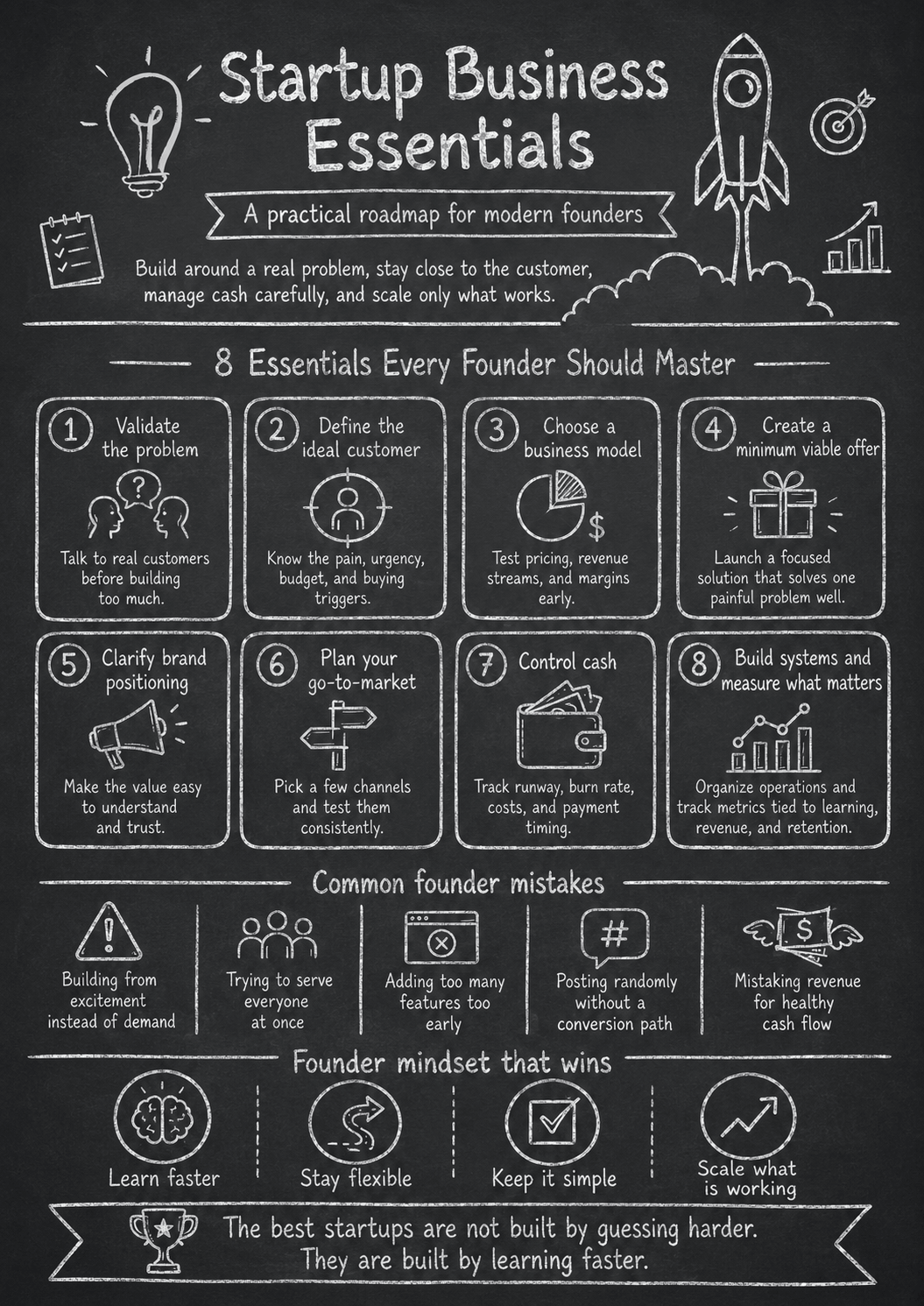
Startup Business Roadmap Final Thoughts
Startup business essentials are not glamorous, but they are powerful. Validate the problem. Know the customer. Build a focused offer. Make the business model real. Create trust. Plan distribution. Protect cash. Build simple systems. Measure what matters. Keep learning.
Modern founders do not need to have all the answers on day one. They need a process that helps them find better answers faster.
A startup is a bet on a better way to solve a problem. When that bet is supported by customer insight, financial discipline, clear positioning, and consistent execution, the odds become much stronger.
The goal is not to look like a successful startup. The goal is to build one that customers understand, trust, use, and recommend.
Startup Business Roadmap FAQ
Startup business essentials are the core elements a founder needs to build a viable company. They include problem validation, customer research, business planning, pricing, branding, funding, marketing, operations, customer retention, and performance measurement.
Before launching, a founder should validate the problem, define the ideal customer, research competitors, test the offer, understand startup costs, choose a business model, and create a basic go-to-market plan.
The most important part is confirming that a real customer has a real problem and is willing to pay for a solution. Without demand, branding, funding, and product development will not create a sustainable business.
No. Many startups begin with customer revenue, founder savings, services, grants, or small initial budgets. Funding can help when the business model supports faster growth, but it should not replace customer demand or financial discipline.
Startups often get first customers through founder networks, direct outreach, content marketing, partnerships, communities, referrals, events, search traffic, paid campaigns, or early access programs. The best channel depends on the customer and business model.
A startup becomes scalable when it can repeat sales and delivery without costs rising at the same speed as revenue. Scalable startups usually have a clear market, a repeatable acquisition channel, strong product or service delivery, and improving margins.
A website is important because it serves as a hub of credibility. It explains the offer, collects leads, supports sales conversations, shows proof, answers questions, and helps people find the business through search.
Founders should track metrics that show learning, revenue, and customer value. Useful metrics include leads, conversion rate, customer acquisition cost, activation rate, retention, churn, revenue, margin, runway, and customer feedback patterns.